Last updated: September 18, 2026 | By Brook, Content Creator for Brittle Enterprises | Family-owned concrete curbing contractor serving Polk and Hillsborough County
Concrete landscape edging is a continuous concrete border, poured in place by a curbing machine, that separates your lawn from flower beds, trees, and walkways. Unlike plastic or metal edging, it has no seams to pop loose, and it holds mulch and soil in place through heavy Florida rain. Most residential projects are installed in a single day and can be finished in dozens of colors and stamped textures. In this guide, we cover how poured edging is installed, the profiles and finishes available, what affects price, how long it lasts in Central Florida, and how to decide whether it is the right fit for your yard.
What is concrete landscape edging?
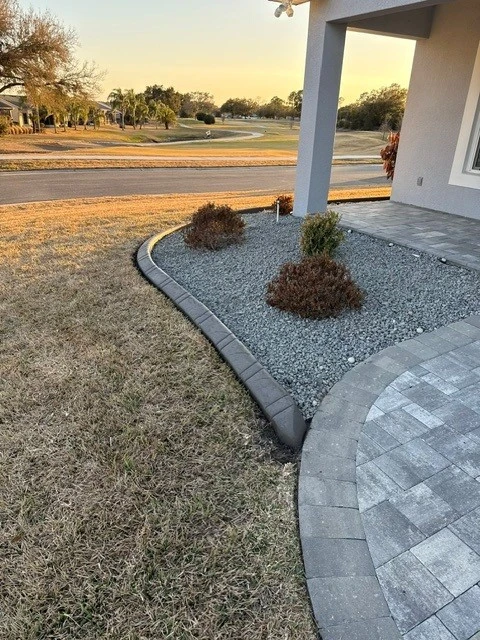
Concrete landscape edging, also called landscape curbing, is a low decorative curb that frames planting beds and hardscape. It is not the same as the tall street curb at the end of your driveway. Residential landscape curbing typically stands a few inches above grade and is shaped to follow the natural curves of your beds.
The key word is continuous. A curbing machine extrudes concrete through a shaped mold, so the border is one solid piece rather than dozens of short sections joined together. Small control joints are cut every few feet so the concrete cracks where we want it to, in straight, nearly invisible lines.
How is poured concrete edging installed?
A professional installation usually follows five steps:
- Layout. We walk the yard with you and mark the curb path with paint or a garden hose so you can see the shape before anything is poured.
- Trenching. A shallow trench is cut along the line and the soil is compacted. A firm base is one of the biggest factors in how long curbing lasts.
- Extrusion. Concrete is mixed on site and fed through the curbing machine, which forms the profile in one continuous pass.
- Finishing. The crew smooths the surface, applies color or stamps if selected, and cuts control joints.
- Curing and sealing. The curb cures in place. A sealer is applied to protect color and reduce staining.
Most homes are finished in one day. You can usually water the lawn around the curb after 24 to 48 hours. Concrete continues gaining strength for weeks, and the American Concrete Institute uses 28 days as the standard age for measuring full design strength.
What styles and finishes are available?
Poured edging is not limited to plain gray. The most common profiles and finishes include:
| Option | What it looks like | Best for |
|---|---|---|
| Mower edge (flat top with lip) | Wide flat surface level with the grass | Letting one mower wheel ride the curb for a clean cut |
| Slant or angled | Sloped face, taller on the bed side | Holding deeper mulch on sloped beds |
| Standard / bullnose | Rounded top | Classic look around flower beds and trees |
| Stamped texture | Brick, slate, cobblestone, or stone patterns | Matching pavers, patios, or home exteriors |
| Integral or broadcast color | Earth tones, grays, reds, tans | Complementing house paint and roof color |
| Flagstone curbing | Natural stone set as a border | Upscale or natural landscape designs |
You can preview patterns on our stamp chart before your estimate. For a deeper look at design choices, see our guide to decorative curbing styles and colors (read the guide).
Why is concrete edging a good fit for Florida yards?
Central Florida puts landscape borders through a lot. Summer storms can dump inches of rain in an afternoon, St. Augustine grass spreads aggressively by above-ground runners, and sandy soil shifts easily. Concrete edging handles each of these better than most alternatives:
- Mulch stays put. A raised, solid border keeps mulch from washing onto the lawn during downpours. The UF/IFAS Florida-Friendly Landscaping program recommends keeping a layer of mulch around plantings to conserve moisture, and a curb helps it stay where you spread it.
- Grass stays out. Runners that creep over plastic edging have a much harder time crossing a solid concrete barrier.
- No UV breakdown. Plastic edging can become brittle and warp in the Florida sun. Concrete does not.
- Less trimming. Mower-edge profiles cut down on string trimming along bed lines.
How much does concrete landscape edging cost?
Pricing is usually quoted per linear foot and depends on total length, profile, color, stamping, site access, and any removal of old edging. Most residential landscape concrete edging projects fall between $5 and $18 per linear foot for professionally installed, standard continuous poured curbing, with Stamped, Textured, or Colored Curb ranging between $15 to $40 per linear foot.
Our full breakdown is in the landscape curbing cost guide (read the guide).
Is concrete edging a DIY project?
Pouring continuous curbing requires a curbing machine, a mixer, and practice to keep the profile consistent through curves. Precast concrete edging blocks are a DIY option, but they are separate pieces that can shift and let grass through the gaps. For a seamless border, most homeowners hire a curbing contractor.
Frequently Asked Questions
Ready to frame your yard?
Brittle Enterprises is a family-owned, licensed and insured concrete curbing contractor rated 4.9 stars from 250+ reviews. You work directly with the owner from estimate to final walkthrough. Schedule your free estimate or call (863) 944-9968 .